
Blockchain Bridging Solutions in 2025: Techniques, Vulnerabilities and the Path to Security
Blockchain Bridges in 2025: How Intent-Based Designs Are Reshaping DeFi

Blockchain bridges handle significant transactional activity, with an estimated yearly volume of $233.22 billion and daily volume of $980.8 million recorded in the past 24 hours as of April 8, 2025, according to DefiLlama Bridge Volume, underscoring their critical role in the DeFi landscape. Blockchain bridges enable interoperability, unlock liquidity and power composability across different blockchain ecosystems. They allow assets and data to move seamlessly between networks like Ethereum, Solana and various Layer 2 solutions, creating a unified multichain environment. Without bridges, DeFi would remain a collection of isolated networks, leading to limiting innovation, scalability and adoption. The significance of blockchain bridges is reflected in their growing usage.
In 2025, bridging solutions have evolved to be more secure and scalable for cross chain interactions. Techniques like ZKPs, decentralised message passing and threshold cryptography reshape how bridges operate. Yet bridges have been the most vulnerable part of blockchain infrastructure, with billions lost to hacks. From the Ronin Bridge exploit to smaller attacks, these incidents have led to an increase in bridging security.
Why Bridges Exist?
Blockchain bridges allow users to tap into diverse liquidity pools and stake assets, boosting their efficiency and reach in the multi chain ecosystem.
Scalability is another advantage, with L2 bridges reducing Ethereum mainnet congestion. They offer fast, low cost transactions, important for DeFi platforms to perform effectively in this ecosystem.
Bridges also increase the adoption of new ecosystems like Berachain and HyperEVM. By connecting these emerging chains to established hubs, they facilitate liquidity and user growth, bringing innovation in DeFi.
What are the Bridging Solutions and Past Bridging Hacks?
According to DefiLlama Bridge TVL Rankings, the TVL across all bridges stands at $33.377 billion as of April 8, 2025. This accounts for approximately 21.4% of the overall DeFi TVL, which reached $156 billion in Q1 2025, as reported by the DappRadar Q1 2025 Report. These protocols, ranging from lock and mint to intent based designs, enable the interoperability for liquidity flow, scalability and multi chain innovation. Yet, bridges have been DeFi’s weakest link, with hacks draining over $2.5 billion. The Ronin Bridge’s $625 million and Wormhole’s $325 million losses are just the tip of the iceberg. Broadly bridging solutions have either centralised working model or a decentralised working model; we’ll cover both their design and mistakes, concluding with the way to safer bridges in the future.
Centralised Bridging Solutions
Centralised bridging protocols have a yearly volume of more than $7.5 billion according to DefiLlama. These protocols are operated and controlled by a single entity or a small group of trusted entities to transfer assets across different blockchain networks. These bridges function by locking assets on a source chain and minting equivalent tokens on the destination chain, managed through custodial control. Their advantages lie in speed, simplicity and ease of integration. Additionally, centralised bridges offer lower transaction fees due to their efficient, coordinated operations, making them appealing to users and developers looking for a straightforward and cost effective cross chain experience.
However, these bridges have downsides like the concern of Single Point of Failure, because the entire bridge infrastructure relies on the security and integrity of the central operator. Beyond security, centralised bridges also require users to release control of their assets, clashing with the foundation of decentralisation and user sovereignty that defines the blockchain space. Furthermore, centralised bridges are more likely to attract regulatory scrutiny due to their structural similarities with traditional financial institutions, which could lead to operational restrictions or enforced shutdowns.
Also, centralised bridging solutions have vulnerabilities that have been exploited in the past, leading to huge financial losses. We will now see a centralised bridging technique and how that has been impacted in the past.
Lock and Mint Bridges
In a lock and mint bridge, a user locks assets on Chain A via a smart contract or custodian. An equivalent wrapped token is minted on Chain B. To reverse the process, the wrapped token is burned and the original asset is unlocked. Centralised versions rely on trusted parties, while decentralised ones use smart contracts with validator networks.
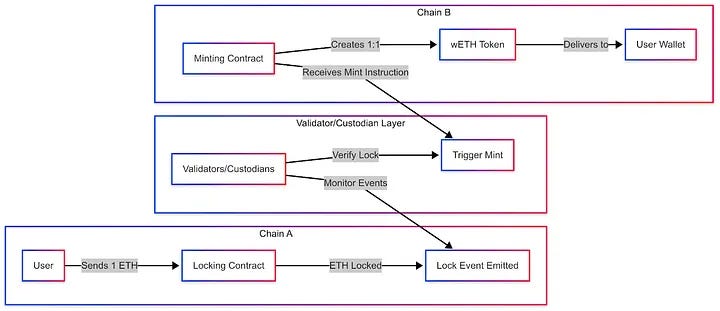
The Ronin and Wormhole hacks show lock and mint bridge weaknesses. In Ronin, hackers stole $625 million by compromising 5 of 9 validators, exploiting centralisation. Wormhole lost $325 million when attackers minted 120,000 wETH via a smart contract flaw from missing validation. Both reveal risks of concentrated control and poor code checks.
To fix lock and mint bridge flaws, multi signature and threshold signatures are important, requiring multiple approvals to remove single point risks like a hacked custodian. Decentralised validators using threshold cryptography spread trust, employing multi party computation to secure keys and block any one party from endangering the system.
Decentralised Bridging Solutions
Decentralised bridging protocols have a yearly volume of nearly $9.5 billion according to DefiLlama. These protocols have become foundational to the multichain blockchain ecosystem by enabling secure, trustless and permissionless transfers of assets and data across different networks. Unlike centralised bridges that rely on a single trusted intermediary, decentralised bridges operate through smart contracts, distributed validator networks and advanced cryptographic mechanisms. Prominent protocols have implemented lock and mint systems using decentralised liquidity pools, while intent based models improve user experience by abstracting complex cross chain operations.
Furthermore, with approaches such as ZK and light client bridging, cryptographic proofs are used to scale and secure interoperability without full node synchronisation. Also, these systems promote greater resilience against censorship and regulatory risks, as control is distributed across many independent participants. Below, we will see about a few decentralised bridging solutions and analyse their working model and past hacks.
1. Burn and Mint Bridges
In burn and mint bridges, assets are burned on Chain A and an equivalent amount is minted on Chain B after finality is confirmed, often via an optimistic delay or fraud proof mechanism. This reduces reliance on custodians but introduces timing risks.
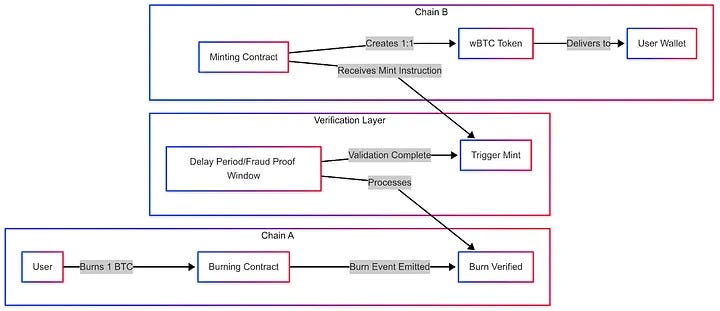
Thorchain hacks show the vulnerabilities of burn and mint bridges, where attackers exploited economic flaws and smart contract bugs, resulting in losses exceeding $8 million across multiple incidents. Weak economic incentives allowed fake deposits to be processed, enabling attackers to drain liquidity pools. Another incident involved a routing flaw, leading to the theft of $5 million.
Burn and mint bridges can enhance their resilience by adopting faster finality mechanisms, such as Tendermint style consensus protocols, which reduce the vulnerability related to slow transaction confirmations. Additionally, strengthening economic incentives is important by imposing heavy penalties for delays or fraudulent behavior, aligning participants’ interests with the bridge’s security and efficiency.
2. Liquidity Network Based Bridges
Instead of locking or burning, these bridges use liquidity pools or atomic swaps. Liquidity providers deposit assets on both chains, enabling instant swaps verified locally by each chain’s validators.
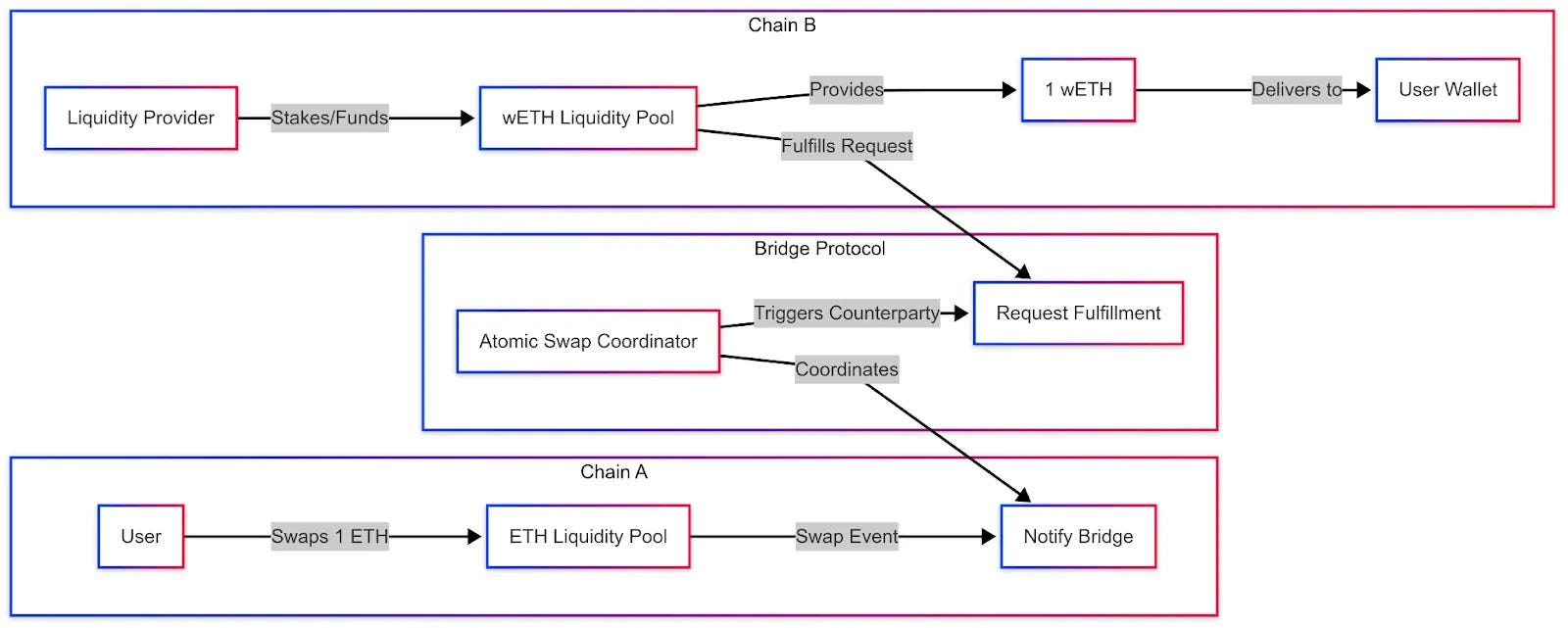
The Nomad Bridge Hack illustrates the vulnerabilities of liquidity network bridges, which resulted in losses of $190 million due to a misconfiguration during an upgrade that reset a root key to zero, allowing anyone to withdraw funds without proper authorization. This failure led to mass withdrawals as users and attackers rushed to drain the bridge. The root cause was poor validation, which failed to prevent unauthorized transactions.
For liquidity network based bridges, ZK liquidity proofs make them more secure, allowing liquidity providers’ contributions to be verified without exposing sensitive details that could be targeted for manipulation. With this, multi layer verification adds another layer of protection by cross checking swaps across independent systems, making it harder for attackers to exploit price manipulation or sybil attacks. Together, this increases the trust and integrity of liquidity driven cross chain swaps.
3. Light Client Based Bridges
These bridges use cryptographic proofs like ZKPs to verify state across chains without trusting validators. Light clients on Chain B validate Chain A’s state directly.
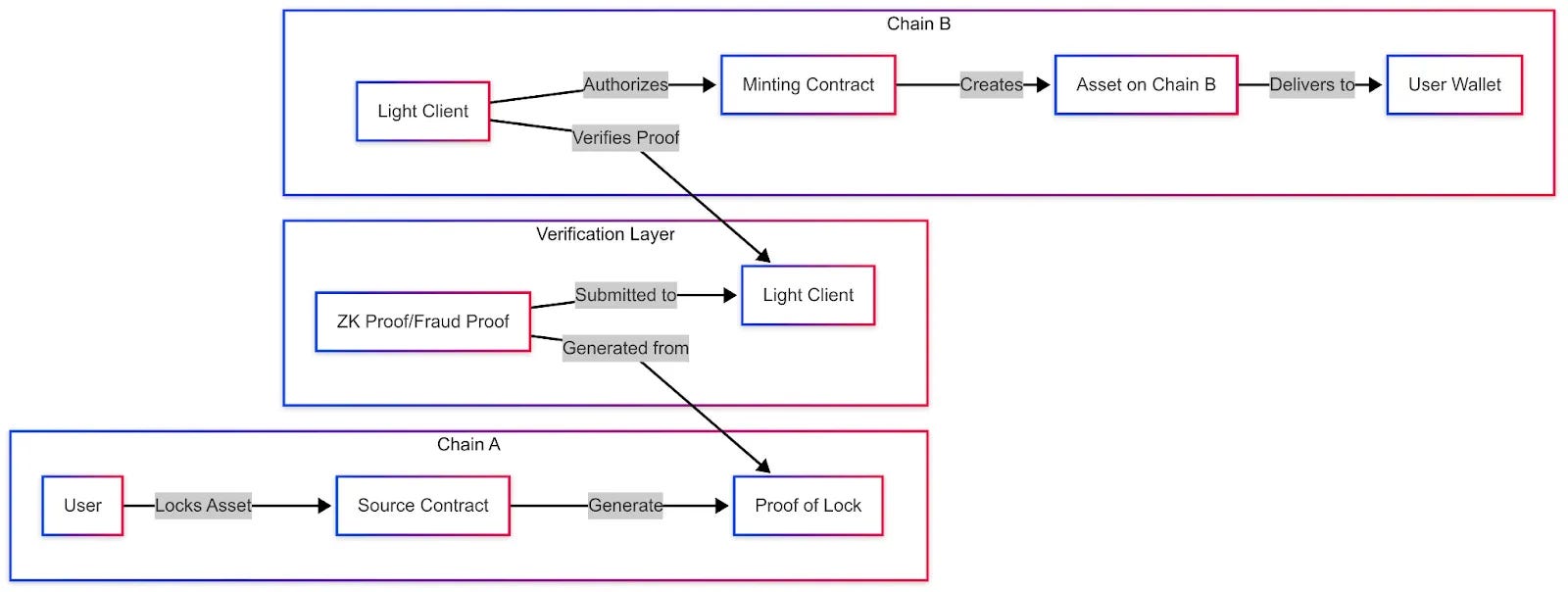
Even though there have been no major hacks in this bridging technique, vulnerabilities for expensive proof generation and state sync attacks are present.
To address these concerns, optimised proof compression techniques can reduce gas costs and computational overhead, making proof generation more efficient. Robust sync protocols can help maintain state consistency across nodes, ensuring that light clients remain synchronized and are safe from desynchronization attacks.
4. Intent Based Bridges
Intent based bridges represent a shift in bridging designs, redefining how cross chain interactions work. Instead of locking, burning, or swapping assets through different protocols, users declare their desired outcome, an intent and off chain solvers or relayers compete to fulfill it, settling the result on chain. This approach reduces the on chain attack possibilities, as execution logic happens off chain, with only final settlement verified on chain. Protocols use this technique for better speed, flexibility and security.
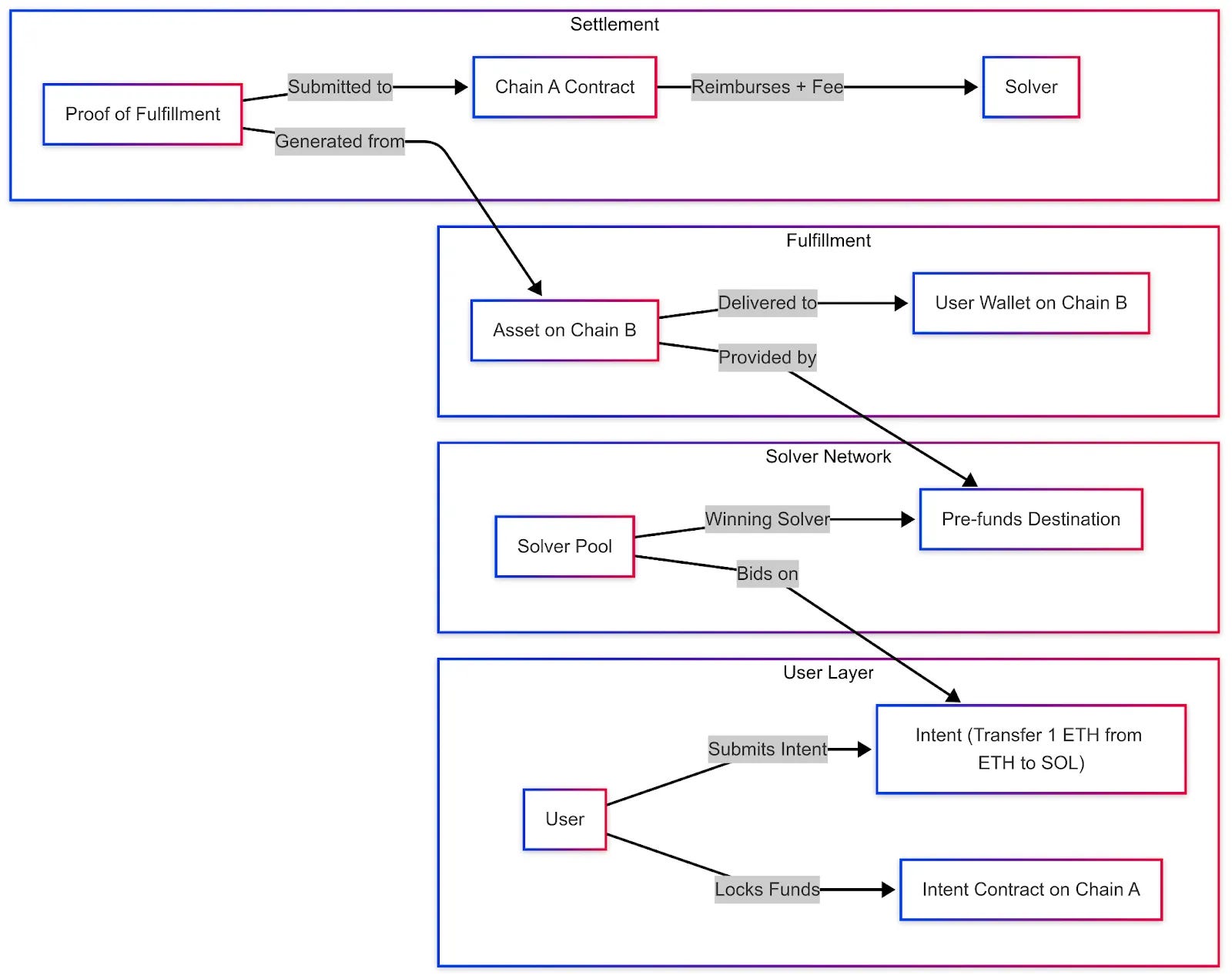
These bridges introduce risks, particularly related to solver collusion, where malicious solvers may delay or censor user intents for their benefit. Another concern is front running, where solvers exploit intent visibility to extract profits before executing legitimate transactions. Also, liquidity risks arise when solvers lack sufficient funds to fulfill their intents, leading to failed transactions.
To address these risks, ZKPs can be used to hide intent details from solvers, preventing front running. Decentralised solver networks with threshold signatures or staking requirements can make the bridge trustless and reduce reliance on any single entity. Dynamic fee models can also enhance bridging security by adjusting fees based on solver performance and market conditions, stopping relayers’ manipulation.
Some Common Vulnerabilities in Bridging
Centralised Custodians
One major vulnerability in bridging techniques is the reliance on centralised custodians, which can become a single point of failure. Attackers only need to breach a few access points to take control of important operations, threatening the integrity and security of the bridge.Smart Contract Bugs
Another risk arises from smart contract bugs, where poor validation or logic errors in the code can be exploited by attackers. Even well audited projects are not safe from unforeseen vulnerabilities, which can be leveraged for malicious purposes, showing the need for scrutiny and robust testing.Finality Delays
Finality delays present another vulnerability, where chain reorganisations or slow consensus mechanisms disrupt transaction confirmation and minting processes. If a blockchain experiences frequent reorgs, transactions could be delayed or even reversed, causing uncertainty and potentially reducing trust in the system. Malicious actors can delay or reverse transactions for personal gain, leading to front running, sandwich attacks and other manipulative behaviors.Sybil Attacks
Another risk comes from Sybil attacks, where malicious actors create multiple fake liquidity provider accounts to disrupt liquidity pools, affecting governance mechanisms, or carry out coordinated attacks. This can destabilise the system and lead to the manipulation of both governance and economic outcomes within the network.
Future of Blockchain Bridging Solutions
Bridges are attractive targets for attackers because of the large amounts of capital they facilitate transferring between blockchains. Despite this, ZKPs, MPCs and decentralised governance show significant promise in enhancing bridge security, making it more resilient to attacks.
Standardization, like ERC 7683, proposes a standardised cross chain interface, aiming to unify Ethereum bridging. This could streamline cross chain communication and reduce vulnerabilities. AI powered monitoring, with real time anomaly detection systems, is being developed to spot suspicious activity and stop potential hacks as they happen. Also, for threats from quantum computing, efforts are underway to prepare with post quantum cryptography, ensuring that bridges remain secure against quantum enabled attacks.
Bridging Implementation in the Dexponent Protocol
The Dexponent protocol’s adoption of a decentralised bridging solution, specifically the Across protocol, enhances the user experience by providing a seamless, secure and scalable cross chain interactions in a multichain ecosystem. By leveraging Across’s intent based system, Dexponent removes the complexity of manual bridging, offering a streamlined, intuitive process. This trustless approach, powered by smart contracts and a decentralised relayer network, removes reliance on centralised custodians, reducing security risks, while empowering users with greater control over their assets. Across’s high scalability, low costs and high speed through competitive liquidity provisioning ensure Dexponent users have a robust experience aligned toward a decentralised infrastructure.
Conclusion
Out of lock and mint, burn and mint, liquidity networks, light clients and intent based approaches, intent based bridges are the standout solution for 2025. Unlike lock and mint bridges, which got affected by centralised flaws, or burn and mint designs, which got affected by timing risks, intent based bridges are reshaping the cross chain protocols’ design. Users declare their intent and off chain solvers compete to execute it, storing only the result on chain. This slashes the on chain attack possibility, offering an alternative to liquidity network or light client bridges.
Intent based bridges also have vulnerabilities like solver collusion, front running and liquidity risks. But with ZKPs, intents can be hidden from greedy solvers, decentralised networks with threshold signatures can increase trust and dynamic fees keep solvers’ behavior in check, which is better than lock and mint’s multi sig patches or burn and mint’s finality corrections. Liquidity networks struggle with price manipulation and light clients face issues with proof costs, while intent based designs reduce these problems by putting complexity off chain, aligning itself with the increase in cross chain transactions.
The design of bridges should focus on security, scalability and momentum. Intent based bridges increase security by minimising on chain targets and scale effortlessly with solver competition. In 2025, intent based bridging is the way to increase speed, flexibility and resilience to lead DeFi’s multi chain future.
Follow us on Twitter/X for the latest updates, insights, and announcements.